The Department of Philosophy at Kirti M. Doongursee College (Autonomous), Dadar, established under the aegis of the Deccan Education Society, is dedicated to the systematic cultivation of critical thinking, ethical reasoning, and philosophical reflection.
Vision
To nurture reflective minds capable of questioning assumptions, evaluating arguments, and engaging with life’s fundamental questions with clarity, sensitivity, and intellectual honesty.
Mission
- To provide a rigorous and comprehensive curriculum in different Global philosophical traditions
- To develop students’ abilities in logical reasoning, ethical analysis, and critical thinking
- To bridge classical philosophical wisdom with contemporary personal, social, and professional challenges
- To create an inclusive and vibrant intellectual community through co-curricular initiatives
What Makes the Department Distinctive
The department offers a curriculum redesigned under the National Education Policy (NEP) 2020, effective from the academic year 2026-27. The programme integrates traditional philosophical foundations with emerging fields such as Philosophical Counselling, Philosophy of Media, Critical Thinking, and Indian Knowledge Systems (Upanishads).
Students are introduced to the full spectrum of philosophy – from the Vedas and Upanishads to contemporary thought experiments, from Greek metaphysics to modern logic, from applied ethics to the philosophy of film. The curriculum is structured to progressively build analytical rigour, interpretive skill, and argumentative competence.
Beyond the Classroom
The department maintains an active co-curricular calendar that includes:
- Tattvajñana Club – The weekly philosophy club where students discuss questions of truth, reality, and value in an open and supportive environment
- Srujan – The Annual Academic Festival – Featuring guest lectures, seminars, film screenings, debates, and creative forums
- Film and Philosophy Series – Regular screenings of philosophically significant films followed by structured discussions
- Guest Lectures – By legal experts, academic philosophers, and distinguished alumni
- Commemorative Events – Honoring the intellectual legacy of former principals and eminent thinkers
Some major features of the department include:
- NEP 2020 Curriculum with Emerging Courses – The department offers Philosophical Counselling, Philosophy of AI, Philosophy of Media, Critical Thinking, and Upanishads as Indian Knowledge System (IKS).
- The Tattvajñana Club – A student-led, weekly and open-to-all philosophy club for discussions, debates, competitions and all other programs which connect fundamental questions and contemporary issues.

3. Interactive way of Learning – The Department not only keeps up with the traditional way of learning, but integrates the modern methods of teaching-learning process and focuses on maximum student interaction.
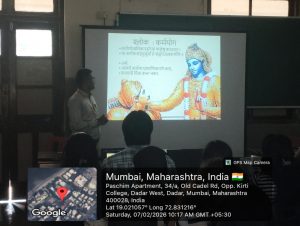
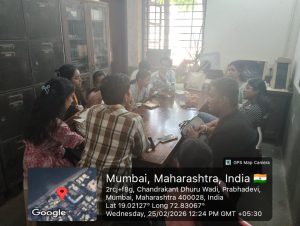
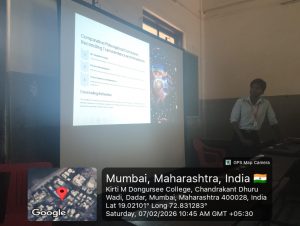
4. Active organization of programs – The Department actively organizes student led discussions, debates, competitions, seminars etc.
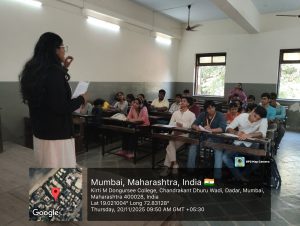
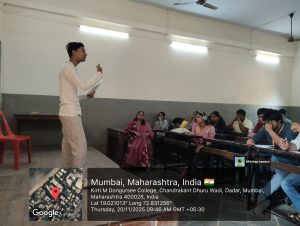
The three year BA in Philosophy Course offers a comprehensive understanding of the vast ocean Philosophical Ideas. From traditional to modern and not only popularized, well-known philosophy branches but also the Philosophers and Philosophical schools which are least-known but contains
The study of Philosophy at the undergraduate level is designed to develop clarity of thought, logical rigour, and the ability to engage with fundamental questions concerning knowledge, existence, values, and society. This program does not merely present a historical survey of ideas. Instead, it trains students to identify assumptions, evaluate arguments, and construct coherent positions on matters ranging from personal ethics to public policy.
The syllabus is structured to progressively build competence. In the first year, students are introduced to the basic branches of philosophy—Epistemology, Ethics, Logic, and Social Philosophy—drawing equally from Indian and Western traditions. The second year applies these foundational tools to concrete issues such as war, poverty, feminism, bioethics, and environmental ethics. The third year offers specialisation in classical Indian systems, modern Western philosophy, formal logic, and textual traditions such as the Bhagavad Gita and Patanjali’s Yoga Sutras.
In addition to the core curriculum, the department offers focused elective courses in Philosophy of Media, Philosophical Counselling, and Modern Philosophy through Textual Studies. These courses are intended for students who wish to explore applied and contemporary dimensions of philosophical inquiry.
The program is governed by the Choice Based Credit System (CBCS) under the National Education Policy (NEP) and is affiliated to the University of Mumbai.
The Department of Philosophy offers a three-year undergraduate program leading to a Bachelor of Arts degree in Philosophy. The program is divided into two distinct streams: the core curriculum spanning the First, Second, and Third years, and a set of specialised elective courses that can be taken alongside the core requirements.
Core Curriculum (First Year to Third Year)
The first year establishes the foundational concepts and methods of philosophy. In Semester I, students are introduced to the nature of philosophy, its branches, and its methods, along with basic introductions to Indian and Western philosophical traditions. A course on Critical Thinking introduces students to the analysis of arguments, the distinction between facts and opinions, and the identification of logical fallacies. Semester II continues with Epistemology, Ethics, and Logic, examined from both Indian and Western perspectives. Additional topics include philosophies beyond the canonical traditions, such as African, Chinese, and Japanese thought.
The second year shifts towards applied and social philosophy. Semester III includes Social Philosophy, addressing the status of women, obligations to the poor, and the ethics of war, alongside Indian Philosophy with a focus on Charvaka, Jaina, and Buddhist schools. A vocational course in Applied Ethics covers bioethical issues and professional ethics. Semester IV offers Political Philosophy, examining social contract theory, ideologies such as Marxism and democracy, and concepts of justice and liberty. Western Philosophy in this semester covers Socrates, Plato, Aristotle, and Epicurus. Another vocational course in Philosophy of Film analyses knowledge, truth, and social themes through cinema.
The third year provides advanced study in specialised areas. Semester V includes Classical Indian Philosophy with detailed treatment of Nyaya, Vaisesika, Samkhya, Yoga, Purva Mimamsa, and Vedanta. Traditional Logic covers categorical propositions, immediate inference, syllogisms, and Venn diagrams. Electives include Philosophy of Bhagavad Gita and Philosophy of Yoga. Semester VI offers Modern Western Philosophy from Descartes to Kant, along with later developments such as Pragmatism and Logical Positivism. Modern Logic introduces propositional calculus, predicate logic, and informal fallacies. Electives continue with the second parts of Gita and Yoga, along with an On-Job Training component.
Specialised Elective Courses
Philosophy of Media
This course examines the philosophical dimensions of various media forms. Topics include the historical evolution of media, semiotic analysis of symbols and images in advertisements and paintings, the structure of auditory media such as radio broadcasts and podcasts, and the analysis of character arcs and symbols in literature. The second part of the course focuses on audio-visual mediums, including the distinction between Philosophy through Film and Philosophy of Film, along with the analysis of ad films, short films, documentaries, and feature films such as They Live and Rashomon.
Philosophical Counselling
This course introduces students to the theory and practice of philosophical counselling as distinct from psychological counselling. The Western approaches covered include Greek Stoicism (Apatheia), Epicureanism, Logic Based Therapy (LBT), and existentialist approaches such as narrative construction therapy and the concept of authentic life. The Indian approaches include Patanjali’s Yoga with concepts such as Citta Vrtti, Klesas, and Pratipaksha Bhavana; Buddhist concepts of momentariness (Ksanikta), non-essentialism (Anatmata), and mindfulness (Samma Sati); and Jaina concepts of Anekantavada and meditation practices such as Preksha Dhyana. The course requires a demonstration and report writing based on self-experience.
Modern Philosophy – Textual Studies
This course engages directly with primary texts from modern Western philosophy. The Indian section includes readings from Daya Krishna’s “Three Myths of Indian Philosophy”, Debiprasad Chattopadhyaya’s introduction to Lokayata, and writings by K. Satchidananda Murty, Gurudev Ranade and Sonopant Dandekar. The Western section focuses on Jean-Paul Sartre’s Existentialism is a Humanism and Martin Heidegger’s critique of technological civilization.
Philosophy of AI
This module, offered as part of the current trends section in the First Year major course, introduces students to philosophical questions arising from artificial intelligence. Topics include thought experiments such as the Brain in a Vat, Mary’s Room, the Chinese Room Experiment, the Trolley Problem, and the Liar’s Paradox. Students are expected to engage with an AI model as part of the practical component.
The Department of Philosophy regularly organizes academic and co-curricular activities to supplement classroom learning and foster intellectual engagement. A summary of activities conducted during the academic year 2025-26 is given below.
- The Tattvajñana Club
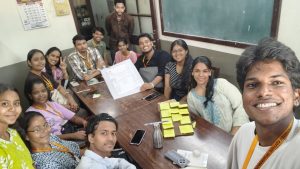
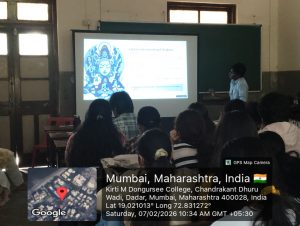
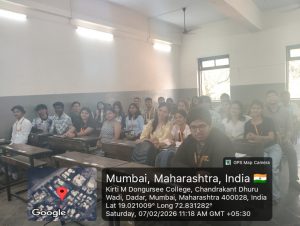

‘The Tattvajñana Club’ led by the students works under the Department of Philosophy. It serves as a regular forum for students to engage in philosophical dialogue beyond the formal curriculum. The club meets weekly during the academic term. Each session is organized around a specific theme, question, or text. Typical activities include:
- Discussion of philosophical questions
- Close reading and analysis of short philosophical texts
- Debate on contemporary ethical dilemmas
- Reflection on films, news events, and personal experiences through a philosophical lens.
And many such activities are conducted by the students. The aim of such a club is to bridge the gap between academic philosophy and lived experience, to provide a platform for open discussions of philosophical ideas and to encourage interdisciplinary dialogue across departments. The club is open to all students of the college, regardless of their major discipline. No prior training in philosophy is required, only intellectual curiosity and a willingness to listen, question, and learn. The Club is open to inter-college collaborations for conducting different activities.
For more details contact:
Email: kcphildept@gmail.com
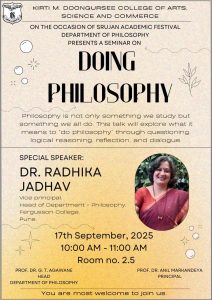
2. Seminar on “Doing Philosophy”: Date 17th September 2025
Resource Person: Dr. Radhika Jadhav, Vice-Principal & Head of Department of Philosophy, Fergusson College, Pune
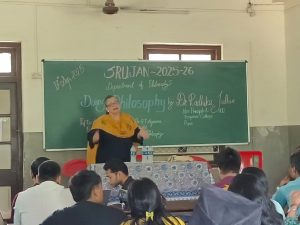
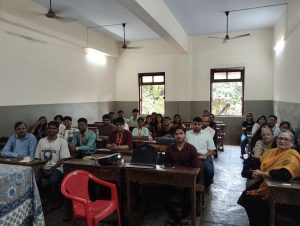
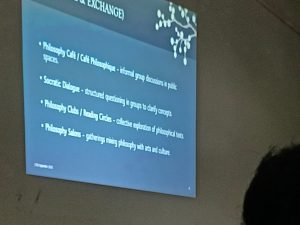
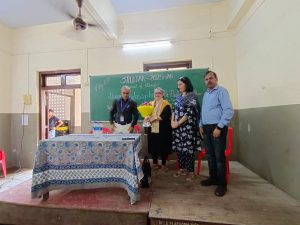
The seminar commenced with a welcome address by Prof. Dr. G. T. Agawane, Head of the Department of Philosophy. Dr. Jadhav delivered an insightful talk distinguishing between ‘studying philosophy’ and ‘doing philosophy’, illustrating how philosophical questioning underpins scientific, ethical, and personal inquiries. The session was highly interactive, with attendees engaging in questions and dialogues. Students acquired an understanding of the active nature of philosophical practice and developed enhanced critical thinking skills.
3. Film Screening – “The Truman Show” : 22nd September 2025
The Truman Show (Theme: Perceived Reality)
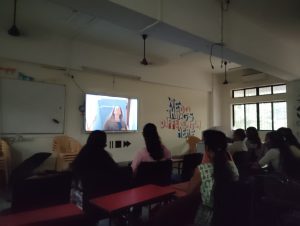
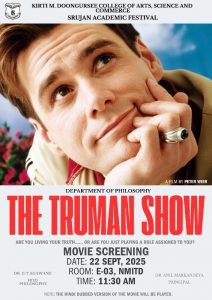
The film presents the story of a man whose entire life is unknowingly broadcast as a television program, raising questions about the nature of reality, the construction of personal identity, the ethics of surveillance, and the meaning of freedom. The screening was followed by an informal discussion. The session prompted meaningful discussion on contemporary issues of privacy, perceived reality, and individual agency in a media-saturated world. The film’s themes resonated across disciplines including Media Studies, Psychology, Sociology, and Computer Science.
4. Bhagavad Gita Day – 1st December 2025
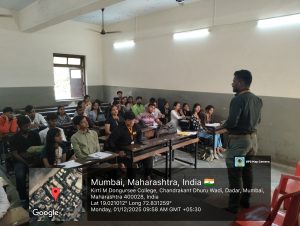
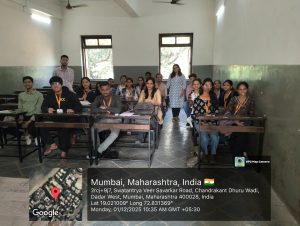
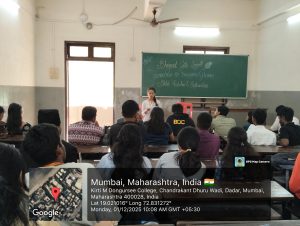
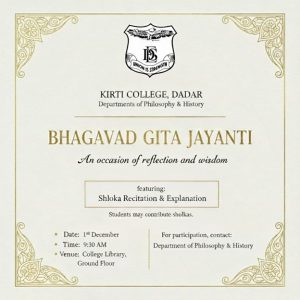
The Department of Philosophy, organized “Bhagavad Gita Day” on 1st December 2023. The primary objective was to foster interdisciplinary dialogue and expose the student community to the timeless philosophical and ethical wisdom enshrined in the Bhagavad Gita. Faculty members and Students from the Department of Philosophy and other departments presented essays on core concepts such as Nishkama Karma (selfless action), Sthitaprajna (the steady-minded individual), Swadharma (one’s righteous duty), and the nature of the Self (Atman) etc.
5. World Philosophy Day – 20th November 2025
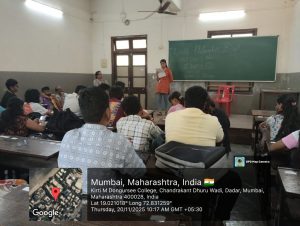
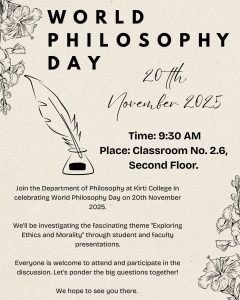
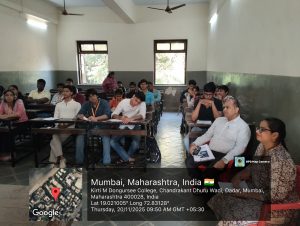
The World Philosophy Day event at Kirti College unfolded as a day of intellectual exchange, centered on the compelling theme of Exploring Ethics and Morality. These students presented their research papers and articles. Some delved into the ethical frameworks of Indian philosophy, exploring concepts such as Dharma (duty), Karma (action and consequence), and Ahimsa (non-violence) from texts like the Upanishads and the Bhagavad Gita. Others engaged with Western philosophical traditions, presenting on the deontological ethics of Kant, the utilitarianism of Bentham and Mill, and the existential reflections of Nietzsche.
The Department of Philosophy takes pride in the consistent academic performance and co-curricular accomplishments of its students. The following achievements have been recorded:
- Aavishkar 2025
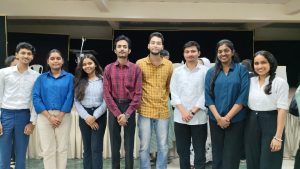
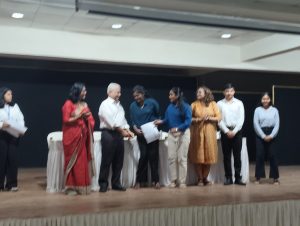
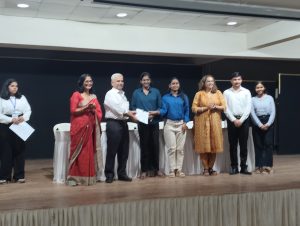
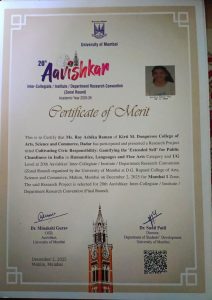
Mr.Jay Rajguru, Ms.Apurva Jadhav, Ms. Ashika Roy and Ms. Rucha Dongare with Faculty guide Mr. Saurabh Mhaske of Kirti M. Dongursee College of Arts, Science and Commerce, Dadar participated and presented a Research Project titled Cultivating Civic Responsibility: Gamifying the ‘Extended Self’ for Public Cleanliness in India in Humanities, Languages and Fine Arts Category and UG Level at 20th Aavishkar: Inter-Collegiate / Institute / Department Research Convention (Zonal Round) organized by the University of Mumbai at D.G. Ruparel College of Arts, Science and Commerce, Mahim. Mumbai on December 2, 2025 for Mumbai I Zone. The said Research Project was selected for 20th Aavishkar Research Convention (Final Round).
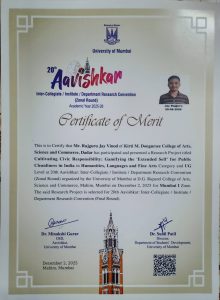
2. Jay Rajguru – TYBA (2025-26)
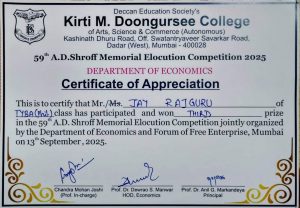
Mr. Jay Vinod Rajguru of TYBA (Philosophy) has participated and presented a speech titled ‘Making India a Global Manufacturing Hub’ and won Third prize in the 59th A.D.Shroff Memorial Economics and Forum of Free Enterprise, Mumbai on 13th September, 2025.
3. Prathamesh Batulwar – FYBA (2025-26)
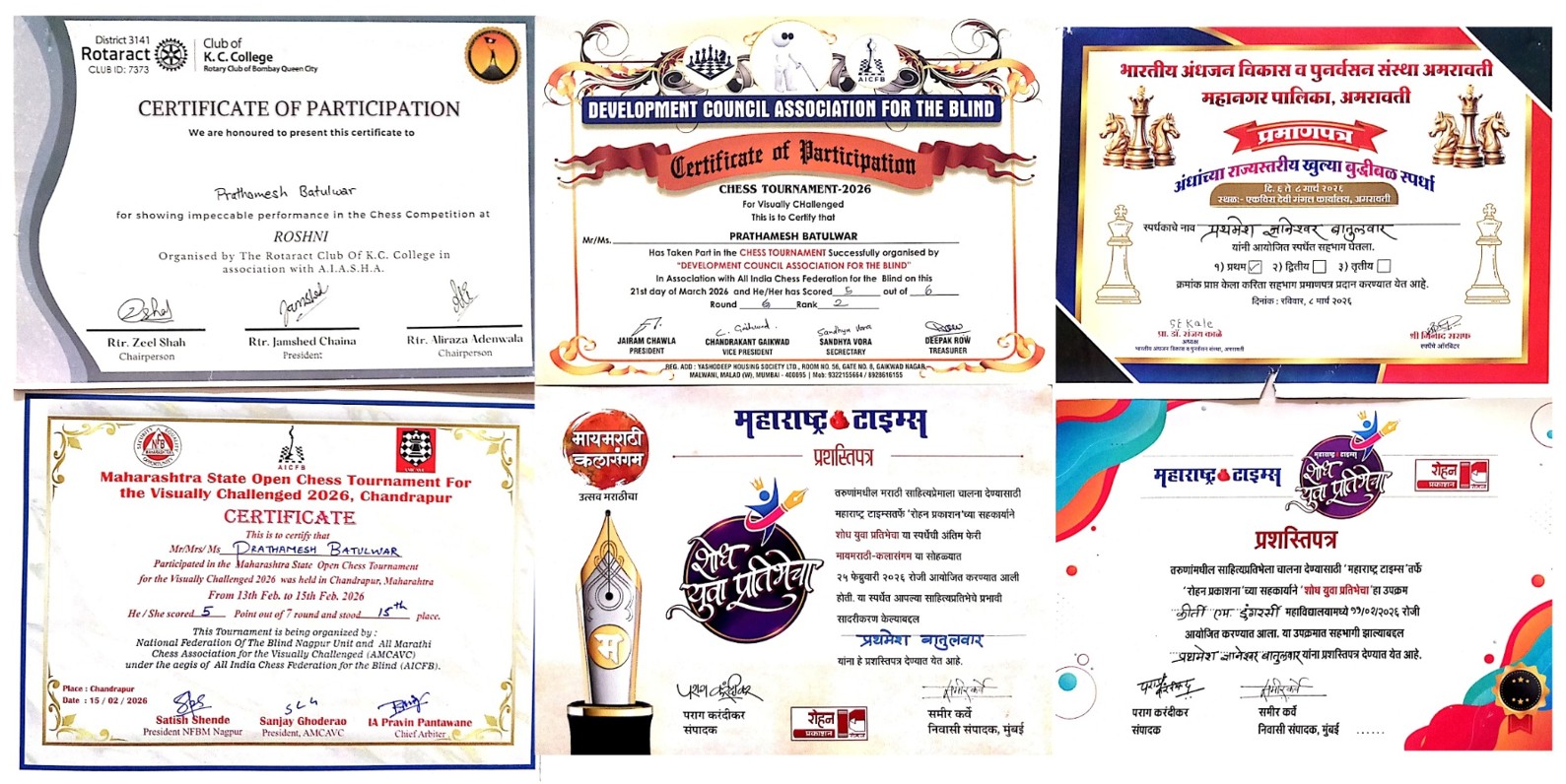
- महाराष्ट्र टाइम्स आयोजित ‘शोध युवा प्रतिभेचा’ – अंतिम फेरी (मायमराठी कलासंगम सोहळा)
आयोजक: महाराष्ट्र टाइम्स आणि रोहन प्रकाशन
दिनांक: २५ फेब्रुवारी २०२६
निकाल: साहित्य प्रतिभेच्या प्रभावी सादरीकरणाबद्दल प्रशस्तिपत्र.
दिनांक: ११ फेब्रुवारी २०२६
निकाल: साहित्य प्रतिभेला चालना देणाऱ्या उपक्रमात सहभागी झाल्याबद्दल प्रशस्तिपत्र.
2. साहित्य आणि सांस्कृतिक उपक्रम
स्पर्धेचे नाव: कीर्ती अंतरंग (KIRTI ANTARANG) – आंतर-महाविद्यालयीन वक्तृत्व स्पर्धा
आयोजक: कीर्ती एम. डुंगरसी महाविद्यालय (सांस्कृतिक विभाग)
वर्ष: २०२५-२०२६
निकाल: तृतीय क्रमांक (3rd Prize)
3. बुद्धीबळ स्पर्धा (Chess Tournaments)
- अंधांची राज्यस्तरीय खुली बुद्धीबळ स्पर्धा (भारतीय अंधजन विकास व पुनर्वसन संस्था व अमरावती महानगरपालिका), दिनांक ६-८ मार्च २०२६ – प्रथम क्रमांक (1st Prize)
- Chess Tournament – 2026 (For Visually Challenged) (Development Council Association for the Blind व AICFB), २१ मार्च २०२६ – ६ पैकी ५ गुणांसह दुसरा क्रमांक (Rank 2)
- Maharashtra State Open Chess Tournament for the Visually Challenged 2026, Chandrapur (NFBM नागपूर व AMCAVC), १३-१५ फेब्रुवारी २०२६ – ७ पैकी ५ गुणांसह १५ वा क्रमांक
- “ROSHNI” Chess Competition (Rotaract Club of K.C. College) – ‘Impeccable Performance’ साठी सहभाग प्रमाणपत्र
- BEYOND SIGHT, Chess Tournament (Anirvedh Charitable Trust व Friends of Aarey), २७ डिसेंबर २०२५ – यशस्वी सहभाग प्रमाणपत्र
- बुद्धीबळ स्पर्धा (मल्हार फाउंडेशन, डोंबिवली पूर्व) – उत्कृष्ट कामगिरीबद्दल सन्मानपत्र
4. वक्तृत्व व काव्य स्पर्धा
- वक्तृत्व स्पर्धा (नेत्र दीप प्रतिष्ठान मुंबई), ४ जानेवारी २०२६ – प्रथम पारितोषिक
· काव्य स्पर्धा (भवन्स कॉलेज, अंधेरी) – सहभाग प्रमाणपत्र
Our alumni have made significant contributions in academia, law, civil services, social work, and education:
NAME | BATCH | BRIEF INFO |
Dr. Ratan Segue | Former Principal, HoD (Philosophy), Kirti College. MA – Philosophy (Gold Medalist) | |
Dr. Shankar Vishwanath Rajadhyx | B.A (Hons), B.Sc., LL B., M.A., LL.M Assistant Professor (Law) | |
Activity 1: Seminar on “Doing Philosophy”
Date: 17th September 2025 |
Venue: Classroom 2.6 |
Resource Person: Dr. Radhika Jadhav, Vice-Principal & Head of Department of Philosophy, Fergusson
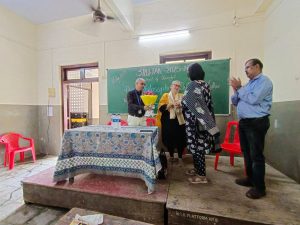
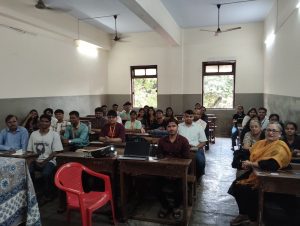
The keynote speaker, Dr. Radhika Jadhav, delivered an insightful talk distinguishing between ‘studying philosophy’ and ‘doing philosophy’, illustrating how philosophical questioning underpins scientific, ethical, and personal inquiries. Through relatable examples, she demonstrated the application of logical reasoning and reflection, while emphasizing the importance of constructive dialogue as a tool for intellectual growth. The session was highly interactive, with Dr. Jadhav encouraging questions and brief dialogues with the attendees. Students acquired a clear understanding of the active nature of philosophical practice and developed enhanced critical thinking and argumentation skills.
Activity 2: Film Screening – “The Truman Show”
Date: 22nd September 2025 | Venue: E-03, NMITD Building | Theme: Privacy, Perceived Reality, Individual Agency
The department organized a screening of the critically acclaimed film The Truman Show, which presents the story of a man whose entire life is unknowingly broadcast as a television program. The film raises profound philosophical questions about the nature of reality, the construction of personal identity, the ethics of surveillance, and the meaning of freedom. The screening was followed by an informal discussion that drew participants from multiple disciplines, including Media Studies, Psychology, Sociology, Computer Science, and Philosophy. The session prompted meaningful discussion on contemporary issues of privacy, perceived reality, and individual agency in a media-saturated world. The film’s themes resonated across disciplines, sparking conversations relevant to students of varied academic backgrounds. The event was attended by 25 participants, including 22 students and 3 faculty members.

Mr. Saurabh Rajesh Mhaske
Assistant Professor & Co-ordinator
(Philosophy) MA (Philosophy), NET Indian-Western Philosophy, Applied Ethics, Contemporary Philosophy

Ms. Gauri Bhosale (CHB)
M.A.(Philosophy) Indian Philosophy, Western Philosophy, Philosophy of Bhagavad Gita, Socio-Political Philosophy
Ms. Janhavi Dhamdhere (CHB)
M.A in Philosophy 2023-2025 Logic, Western Philosophy, Indian Philosophy, Critical Thinking, Philosophy of Yoga, Political Philosophy